Roblox puzzle games can ask very different things of you: interpret a clue, explain something your partner cannot see, or coordinate movement across an obstacle course. Choose the kind of thinking you enjoy before choosing a title. This guide compares three distinct formats with direct links to their creators’ Roblox listings, without revealing room solutions.
Choose a puzzle format first
| Experience and creator | Listed format | Choose it when | Check first |
|---|---|---|---|
| Untitled Door Game — Door Game Community | Code doors, conceptual puzzles, and difficult obbies | You want clues mixed with skill challenges | Whether you enjoy platforming alongside puzzle solving |
| Isolator — Nullxiety | Two separated players exchange information | You want to explain clues to a partner | That both accounts can communicate in the intended way |
| Teamwork Puzzles Obby — Flux Games | Team puzzles and obstacle levels for different group sizes | You want coordination and movement | Which level supports your current group |
These are editorial matches to creator-described formats, not a hands-on quality ranking or a live popularity chart. Listings were checked November 8, 2026. Current access requirements, devices, communication features, and available modes can change; check the experience’s current Roblox page before arranging a session.
Untitled Door Game: clues mixed with obstacle skills
Untitled Door Game by Door Game Community describes code doors, conceptual puzzles, and difficult obbies. The creator also warns that later rooms become harder. This is the pick to investigate when you want reasoning and execution in the same experience.
Before starting, decide whether a platforming challenge is a welcome part of your puzzle session. A player who likes deduction may still prefer a game without demanding movement. Separating those preferences helps you choose a better fit than simply searching for the hardest puzzle.
For a first session, keep notes about what you observed and what you inferred. If a guess fails, change one assumption at a time. Avoid immediately searching for a room code if discovering the rule is the part you want to enjoy. This guide intentionally leaves solutions out.
For a creator studying this format, consider whether a failure means “my answer is wrong” or “I did not execute the movement.” Those are different feedback needs. An original prototype should make that distinction readable instead of leaving players unsure which skill failed.
Isolator: explain the clue your partner cannot see
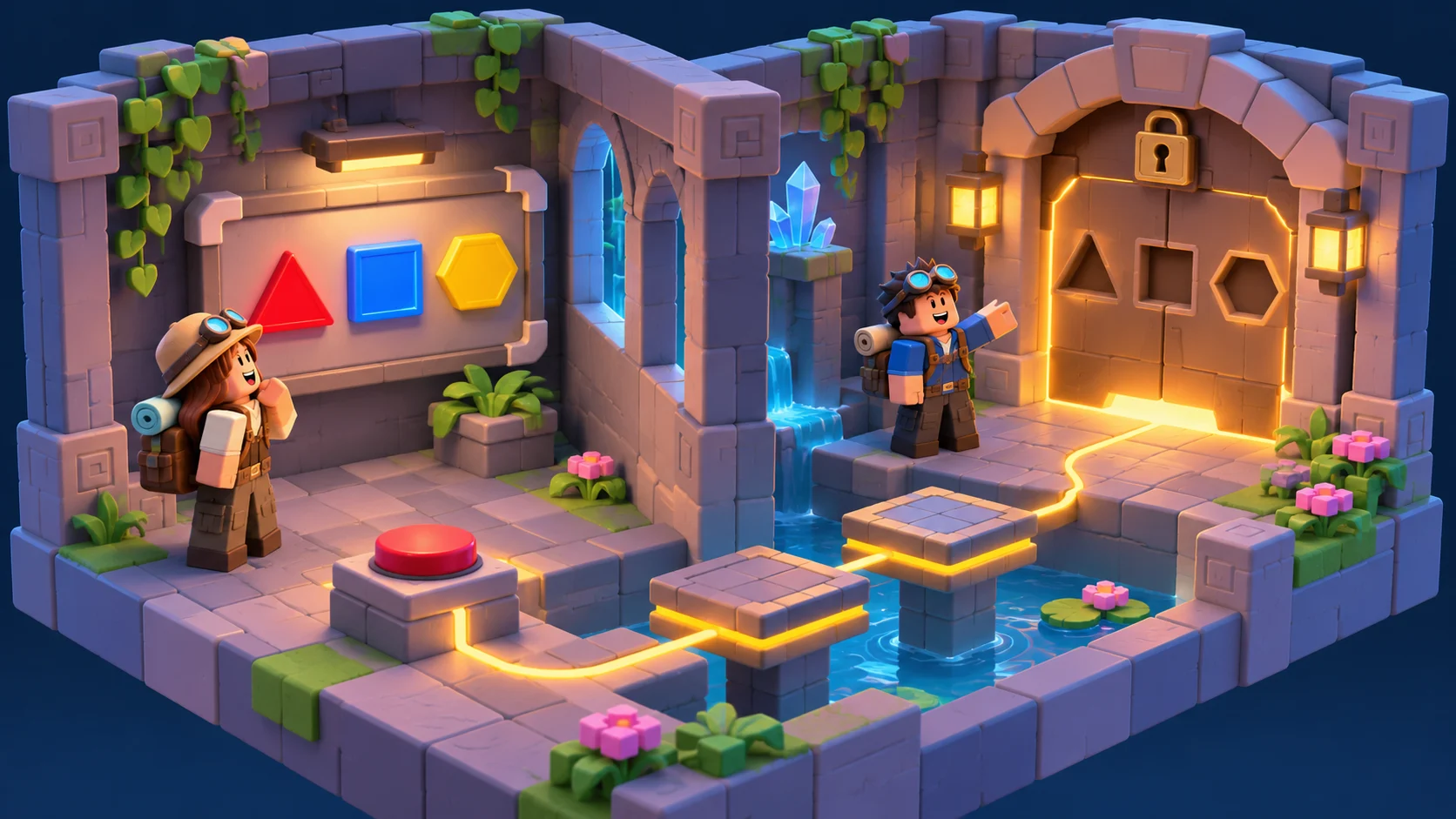
Isolator by Nullxiety describes two players separated by a wall, escaping by exchanging information through chat. Its example is a lock on one side and the corresponding code on the other. The listing says it is not a horror game and warns that leaving affects the partner’s run.
Choose this format when communication is the challenge you want. Before committing to a session, confirm that you and your partner can use the communication the experience requires under your current account settings. If that path is unavailable, choose another format rather than assuming the puzzle can be completed without it.
A useful communication habit is to separate description from instruction. First say what you can actually see; then agree on what to try. Establish a shared way to name positions or shapes so “the one on the left” does not mean something different on each side.
For an original two-player puzzle, test whether both roles have meaningful information. If one person supplies a solution while the other merely waits, the roles may feel uneven. A small prototype with one clue exchange is enough to test whether the conversation itself is interesting.
Teamwork Puzzles Obby: coordinate the group’s movement
Teamwork Puzzles Obby by Flux Games describes team puzzles and obby levels, including several group sizes. Its current title advertises two through five players, while the description also mentions solo levels. Check the selected level rather than assuming every course supports the same number of people.
This is the option to investigate when you want a puzzle session with movement and coordination. Agree on a plan before everyone starts acting. If a teammate needs to hold a position, confirm that role before another player leaves the area.
Choose a level that fits the people who are actually present. A larger advertised group size is not a promise that a smaller group can bypass the missing role. For other duo formats, see the broader two-player Roblox games guide.
A creator can test the same idea with two clearly labeled positions and one shared goal. Check whether players understand why both roles matter. Add more steps only after a new pair can solve the first interaction without an explanation from the designer.
Pick by thinking style, group, and movement
- Clue interpretation plus execution: investigate Untitled Door Game, remembering that obbies are part of its description.
- Two people with different information: investigate Isolator after checking communication access.
- Coordinated obstacle solving: investigate Teamwork Puzzles Obby and select a level for your group size.
If your group prefers making something to solving a fixed problem, the drawing games comparison offers a different creative session. If you prefer a repeatable progression loop, compare Roblox simulator games. Neither preference is a measure of puzzle skill; it is a different way to spend the session.
Get unstuck without spoiling the whole room
- Restate the goal. Identify the object or state you are trying to change.
- Inventory the evidence. List visible clues before deciding what they mean.
- Separate observation and inference. “There are three shapes” is different from “the answer must have three digits.”
- Try one hypothesis. Avoid changing several inputs at once if you want to learn what mattered.
- Compare perspectives. In a team puzzle, another player may have information you cannot access.
- Take a smaller hint. Prefer a hint about the rule over a complete answer when discovery is still the goal.
These are general puzzle-solving suggestions, not verified solutions for a specific room. Some challenges also test platforming or coordinated execution, so a correct idea may still need a successful attempt.
Build one original puzzle interaction
Write a short rule before opening Studio: what can the player observe, what can they change, and what feedback confirms progress? Start with one room or interaction so you can see whether players understand the relationship.
Use attributes for explicit object state, ProximityPrompt for a scoped interaction, and CollectionService to discover related objects without relying only on names. The debounce guide explains how repeated events differ from distinct accepted actions. These are building exercises; a complete cooperative puzzle still needs its own rules, reset behavior, and multiplayer tests.
For a session built around making a creation instead of solving a fixed room, compare Roblox building games.
For a session organized around an ascent and shared route goals, compare these Roblox climbing games.